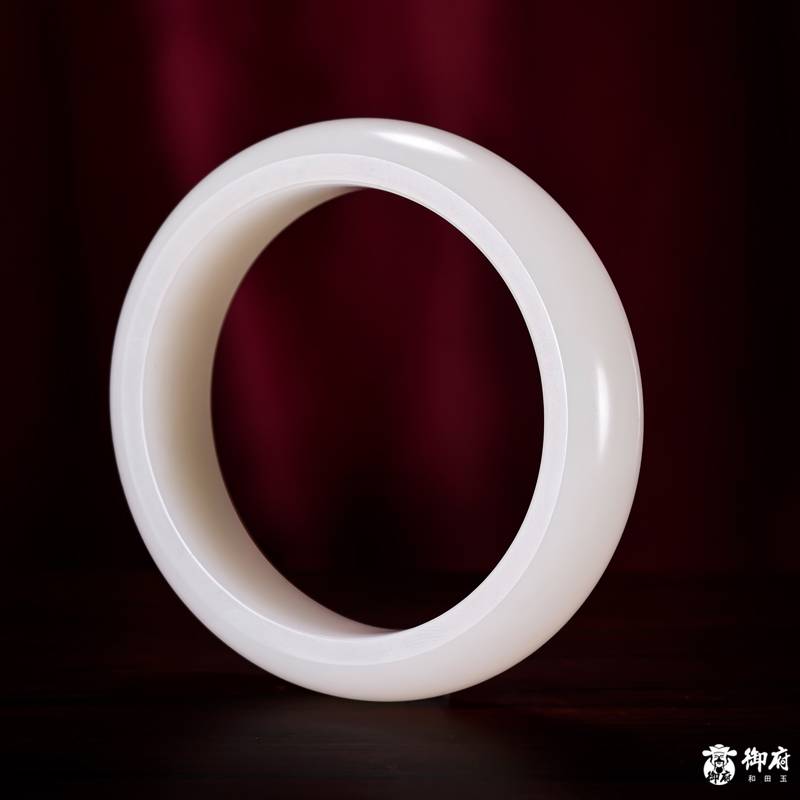
There is no honest single price for a Hetian jade bangle. Two pieces can both be called white nephrite and still differ sharply in structure, condition, size, treatment and evidence. A useful valuation starts by comparing like with like, not by chasing one flattering word in a listing.
The price is built from several variables
For a practical comparison, record seven fields for every bangle: material, stated origin, colour, grain and translucency, dimensions, condition, and documentation. If one field is missing, the price is not directly comparable. A 58 mm bangle weighing 84.9 g is not a fair comparison for a 51 mm piece weighing 67.4 g, even when both listings say white jade.
- Material: nephrite or jadeite, with treatment disclosed.
- Size: inner diameter, width, thickness and actual weight.
- Condition: chips, repairs, filled areas and structural lines.
- Evidence: laboratory report, supplier record, or a clearly stated opinion.
Size changes the amount of stone
For bangles with a similar profile, mass rises roughly with the square of the inner diameter and the cross-sectional area. This is not a pricing formula, but it explains why a wider 58 mm bangle can contain much more material than a slim 52 mm bangle. Compare weight and profile together instead of paying a premium for diameter alone.
- Ask for measurements in millimetres, not only a size label such as small or medium.
- Compare weight only when width and thickness are also close.
- A larger bangle with a thin profile may contain less material than a smaller, thick round bangle.
Colour words are not laboratory grades
Terms such as mutton-fat, icy, high white, or premium are trade descriptions, not universal grades. White nephrite commonly shifts from cool white to warm cream, grey or a slight green cast. Ask for daylight photographs beside a neutral white card and a millimetre ruler. That gives your eye a reference instead of a warm studio background.
- Treat vivid marketing adjectives as claims that need examples.
- Check whether colour is even through the body or concentrated near the surface.
- Do not compare a retouched image with an unedited daylight photograph.
Condition can outweigh appearance
A tiny surface line that ends inside the stone is a different risk from a crack that reaches an edge or inner ring. Repairs and filled cavities should be priced as condition issues, even when the bangle looks attractive from a distance. Ask for close images at the inner ring, outer edge and any carved detail.
- Request a written condition statement for the exact piece.
- Ask whether a visible line is an inclusion, polish mark, repair or structural crack.
- Clarify who pays if an undisclosed condition is found after delivery.
Documentation changes the risk
A laboratory report can confirm material and disclose detectable treatment, but it may not prove a geographic origin such as Xinjiang. That distinction matters. A report with a number you can verify, a matching photograph and a clear treatment conclusion reduces uncertainty. It does not automatically make an average bangle valuable.
- Check the laboratory name, report number and issue date.
- Make sure the report photograph matches the bangle being offered.
- Separate tested facts from a seller's origin or rarity opinion.
A sensible way to compare quotes
Put each quote in a simple table and leave a blank cell where the seller has not answered. If one bangle has a lower price but no treatment statement, exact measurements or return terms, the apparent saving may simply be unpriced risk. For a high-value purchase, the cost of independent verification is part of the buying budget, not an optional extra.