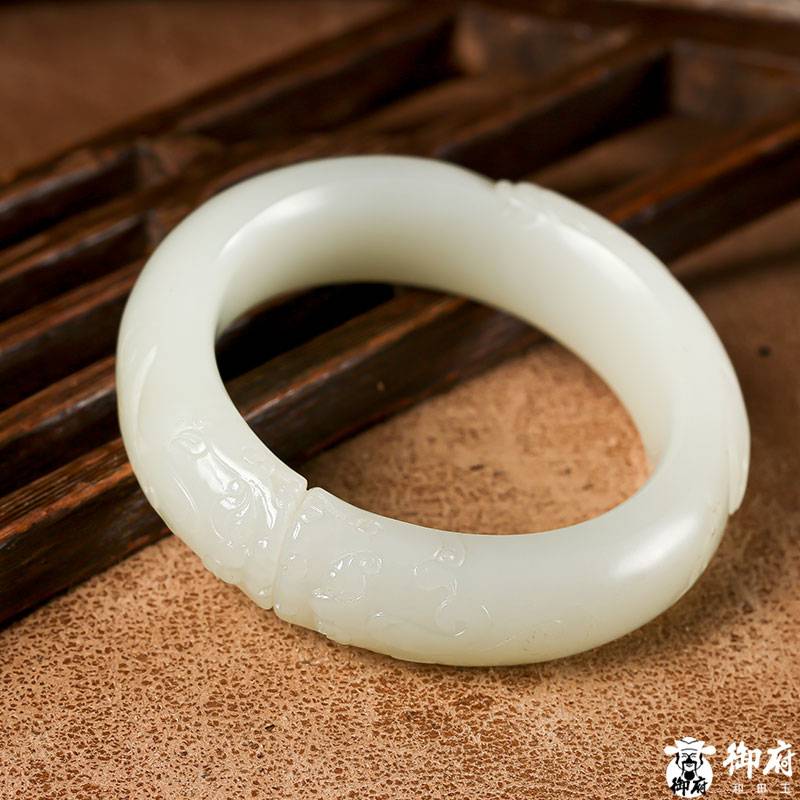
Natural nephrite is not a painted surface. Its appeal comes from how colour, grain, translucency, and polish work together. The goal is not to find a perfectly uniform stone, but to understand what you are seeing.
Colour is a range, not a single grade
White nephrite can lean cool, warm, grey, or slightly green. Two bangles described as white may look very different in daylight. Compare photographs taken in neutral daylight, ideally around 5000-6500 K, and place a white card or millimetre ruler beside the stone. This gives your eye a reference instead of a warm studio background.
- Compare the stone in daylight and indoor light.
- Look for whether the colour is body-deep or only concentrated at the surface.
- Treat words such as icy, mutton-fat, or premium as descriptions that need context, not laboratory grades.
Grain and translucency
Fine grain can create a soft, even appearance, while coarser structure may be visible as fibres or cloudy areas. Translucency depends on thickness, lighting, and the structure of the stone. A thin edge may pass light even when the body is not highly translucent.
- Ask for a side view that shows thickness.
- Watch how light moves across the surface rather than judging one highlight.
- Do not confuse reflected glare with translucency.
Inclusions and condition
Small clouds, lines, mineral spots, or colour variation may be part of natural structure. A crack that reaches the edge, a filled cavity, or a chip on the inner ring is a condition issue that should be disclosed separately.
- Request close-ups of every visible line or spot.
- Ask whether a line is a surface mark, an inclusion, a repair, or a structural crack.
- Confirm the return policy if the condition is difficult to judge from images.
A better question than "Is it perfect?"
Ask whether the stone is structurally sound, honestly represented, and attractive in the light where you will wear it. A natural bangle can have character without being damaged, and a very uniform bangle can still be treated or poorly documented.